The Global Jobs Index provides harmonized, internationally comparable estimates of the availability and quality of employment across countries and over time. This page describes the data sources, indicator definitions, modeling approach, and limitations.
The Authors


This methodology was developed by Impacc and the Kiel Institute for World Economy.
About the Kiel Institute for the World Economy
The Kiel Institute for the World Economy is Germany's leading research institute on global economic affairs and one of the most renowned institutions in Europe and worldwide in this field. It combines top-quality research comparable to that of leading universities with a visible and lasting influence on national and international economic policy. https://www.kielinstitut.de/
Tobias Heidland
Tobias Heidland is professor of economics and Research Director for international development at the Kiel Institute for the World Economy.
About Impacc
Impacc seeks to establish a new form of global aid – one that empowers rather than provides. The non-profit organization converts donations into investments in African startups, aiming to create sustainable jobs and increase local self-reliance. It invests in local founders with ideas for local markets, providing financial, technical, and operational support. The model combines elements of traditional development cooperation with the principles of venture capital. Founded by a team led by former Welthungerhilfe CEO Till Wahnbaeck, Impacc is based in Hamburg, Germany, with teams also operating in Kenya and Ethiopia. https://impacc.org
The Dataset:
The Global Jobs Index is an annual panel data set. The dataset starts in 2000, then tracks annual developments up to the present day and projects developments up to 2060. There are three identifiers: country (country name, ISO3C), year, and scenario (Shared Socio-Economic Pathway development scenarios, SSP).
Data Sources:
The Global Jobs Index is based on a combination of different data sources. The most important basis is labor market data from the International Labor Organization (ILO), in particular from Labor Force Surveys (LFS) – nationally representative surveys on the labor market situation. These are supplemented by further ILO statistics that provide information on the working-age population and the employment situation. In addition, World Bank indicators (World Development Indicators) and World Bank country classifications are used to distinguish between different labor market definitions for low/middle-income and high-income countries. For forward-looking projections, the GJI uses the recognized Shared Socio-Economic Pathway (SSP) scenarios, which also form the basis of the IPCC climate reports and model various development paths for population and economy.
Definitions:
Job categories:
- Jobs below the poverty line: Workers who earn less than $3 per day despite being employed (adjusted for purchasing power; this corresponds to the absolute poverty line). They work, but can barely afford the bare necessities.
- Gig jobs: Workers who are above the absolute poverty line but may need to take on several side jobs (“gigs”) to reach the income level of big jobs. Since the poverty line is defined in absolute terms, this allows for comparisons between different countries.
- Big jobs: Employees who have only one job and earn more than two-thirds of the country-specific median income. These jobs often correspond to the minimum wage and offer relative financial security. Depending on the country, the median income can be high or low; similar to the relatively defined poverty figures in the EU, this is a comparison within the country.
The Jobs Gap (the employment gap):
- Employed population who have neither a big job nor a gig job.
- This group therefore includes people who work but are poor/live in precarious circumstances, as well as people who do not work at all. This includes the unemployed, discouraged workers (who are unemployed but have given up looking for work), and people who are no longer in employment (e.g., people in education, people with disabilities, people who are unable or unwilling to work of their own accord).
The Model:
- The various data sources are integrated into a common database in panel data form (i.e., country - year - scenario). Each input data set is restructured to fit into the structure of the overall data set. Country names and other identifiers are standardized so that the data sets can be combined. The imports, preparation, and processing are written entirely in program code in the Stata statistical software, so that updates are easy to make and run largely automatically. This ensures complete replicability.
- This database can then be used to determine the average correlation between job growth economic development, and population growth. For the past, we can use official survey data and estimates from the ILO. For the future, it is necessary to make assumptions about how key factors will develop. For this purpose, we use the SSP scenarios, specifically the SSP4-Scenario (Release 3.1 from July 2024). We use as few variables as possible, because for each variable we use to model the GJI over time and between countries, we have to make our own assumptions for the future. The two core variables are country-specific GDP per capita and the size of the male and female working-age population. All other variables are therefore implicitly assumed to remain unchanged—a necessary assumption to reduce complexity.
- We estimate the correlation between these variables and the employment rate (specifically by world region and gender) as well as between the size of the working population, per capita income, and the number of big jobs, gig jobs, and jobs that pay less than $3/day. This average correlation then allows us to project the GJI into the future. This gives us estimates of how the GJI will develop, for example, when comparing two countries. Each country has its own starting points calculated from the data, so that model estimates and projected changes result in a continuous time series.
Data Availability
The Global Jobs Index is based on survey data compiled by national statistical offices, which collect information on employment and wages. These data points are marked as “ground truth data” in the data visualization. The surveys are not conducted by every country every year. If there are gaps for a single country, we have filled them using interpolation—for example, two data points that are three years apart are connected with a line. There are also periods that lie before or after the last measured data point. In this case, we use the regression models underlying the index to predict the likely trend in the figures using per capita GDP and the working-age population.
The Visualizations:
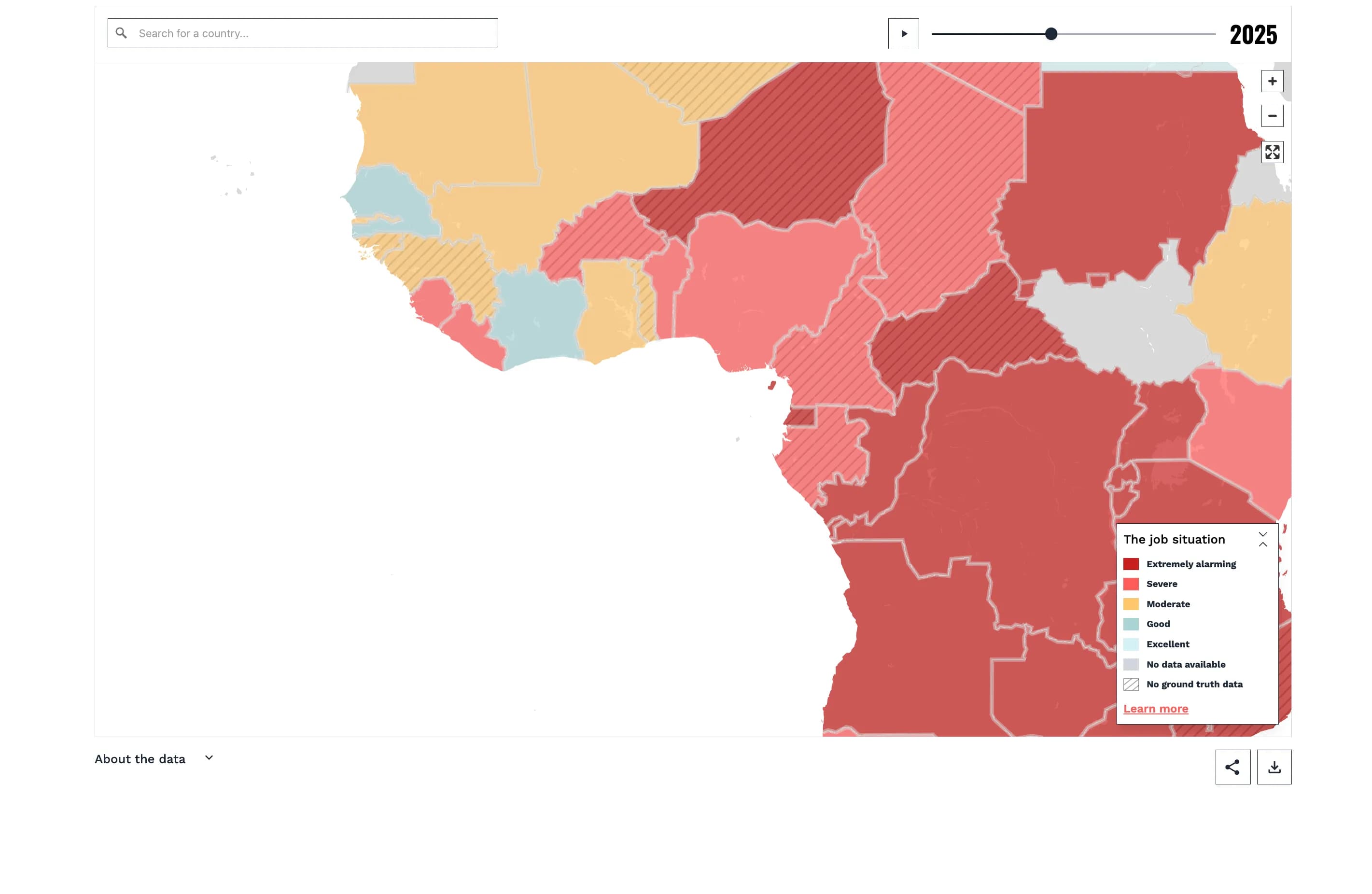
Interactive Map: From extremely alarming to very good: the map shows the employment gap in relation to the working-age population as a percentage. The “Play” button shows how it changes over time. Moving the cursor over a country displays the figures; clicking on a country shows the development from 2000 to 2060.
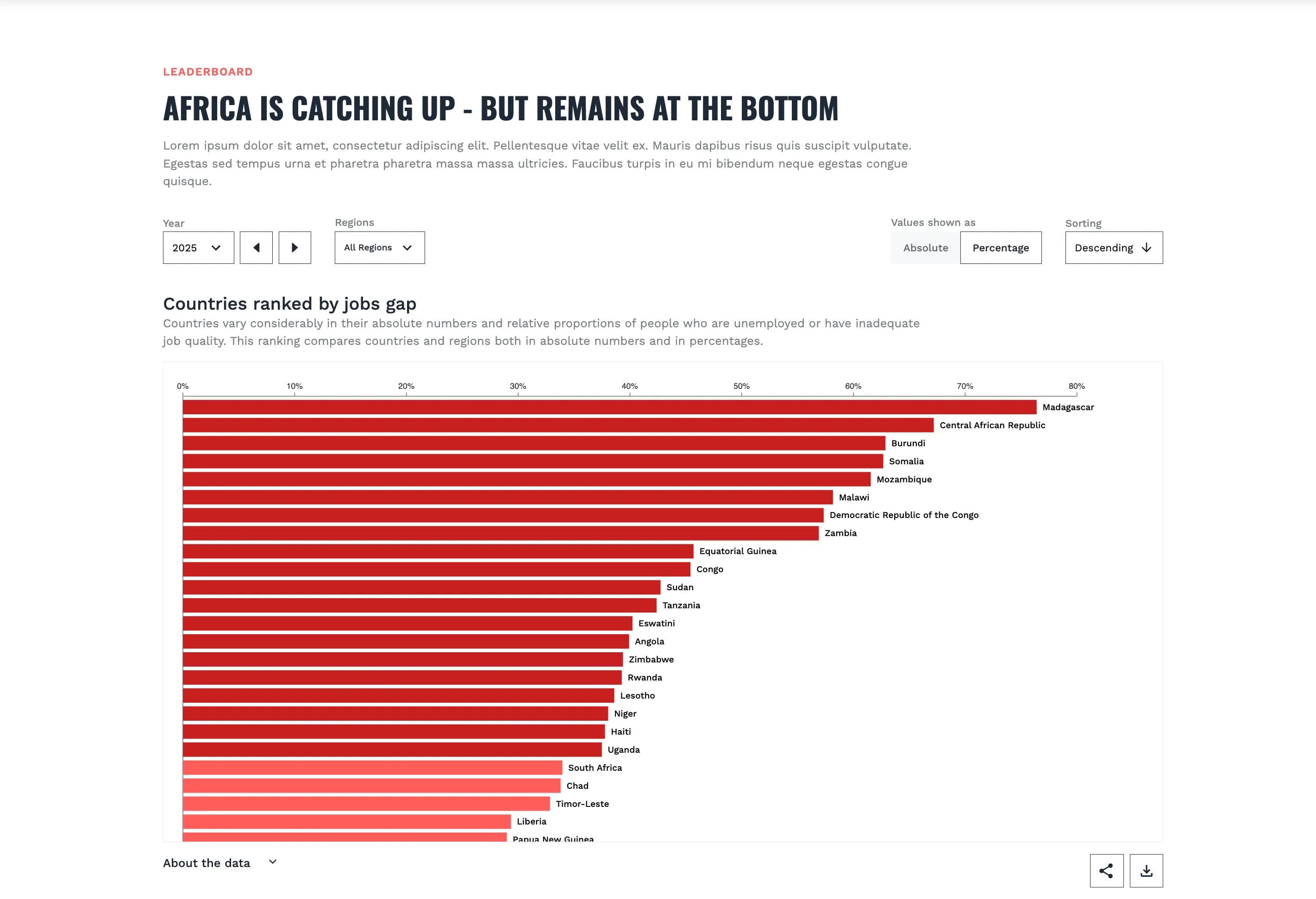
Who leads the list, who is last? And how do the positions change over time? The ranking list - sorted either by absolute numbers or by percentage values - uses the color classification from dark red (“extremely alarming”) to light green (“very good”).
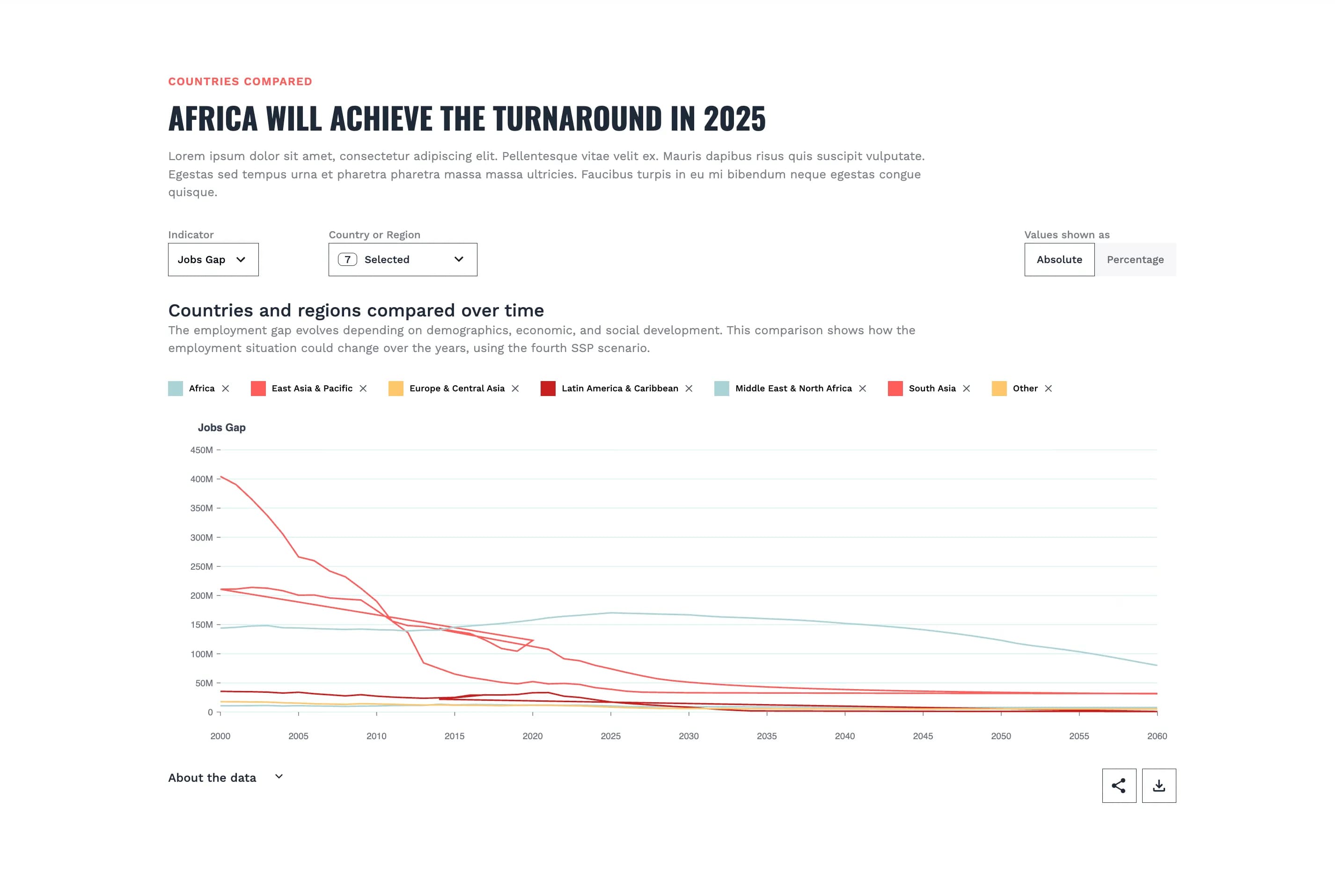
Jobs gap, Big Jobs, Gig Jobs: Here you can compare countries and regions relative to size or in absolute numbers.
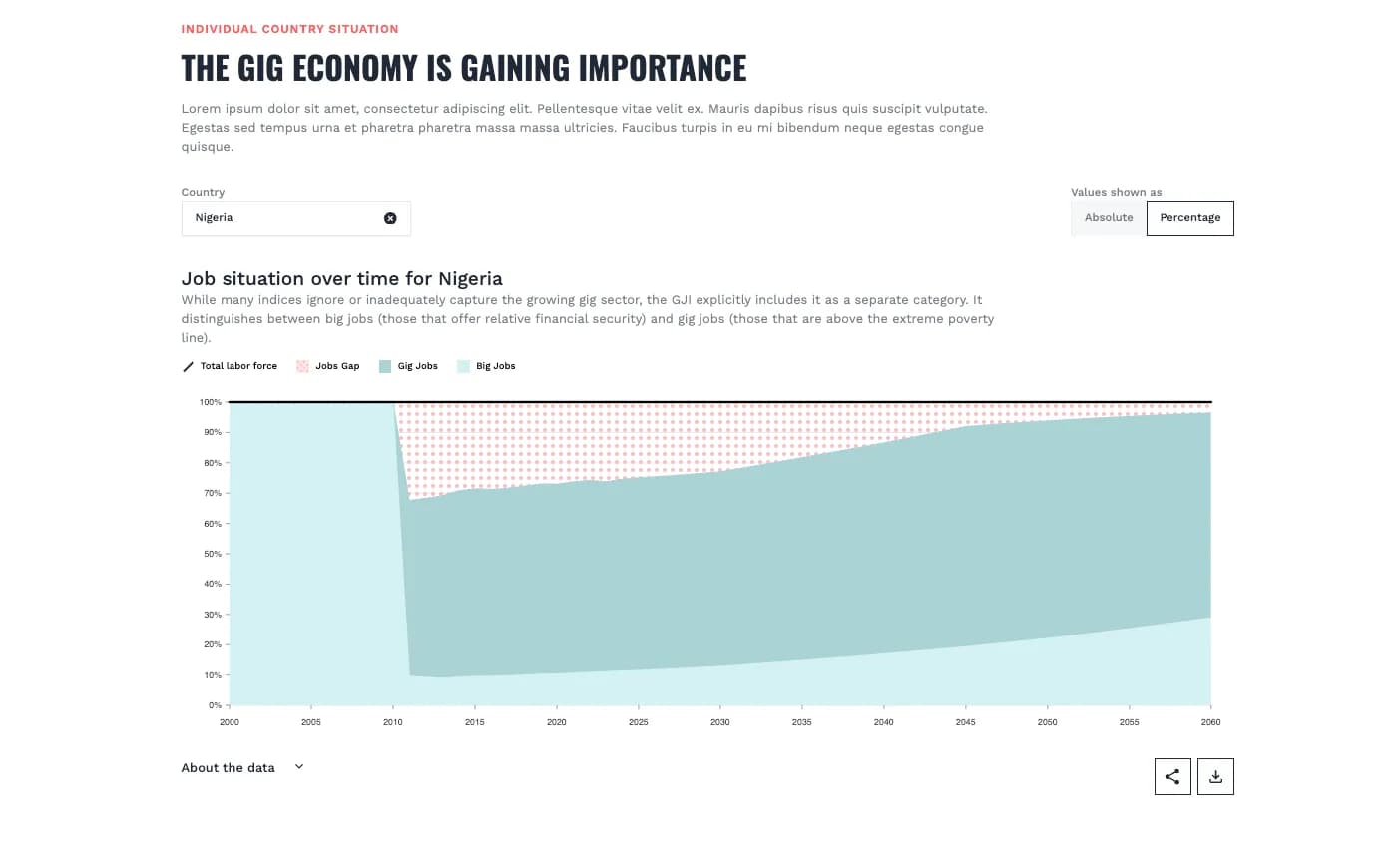
While many indices ignore the growing gig sector or fail to adequately capture it, the Global Jobs Index explicitly integrates it as a separate category. Here, jobs are divided into big jobs (which offer relative financial security) and gig jobs (which are above the extreme poverty line).
Download the dataset
If you want to use the data, please cite it as: "Heidland, T. and Wahnbaeck, T. (2025). Global Jobs Index, Dataset Release 1.0" The data can be used under CC-BY 4.0. We are happy if you drop us an email about your use of the data.
Download CSV